eCommerce AI | Web Apps | AR/VR Software – ECA Tech

- Home
- The Shift Toward Patients Before Paperwork: A Two-Part Deep Dive into MedTech SaaS
The Shift Toward Patients Before Paperwork: A Two-Part Deep Dive into MedTech SaaS
May 8, 2026 - Technology
Part 1: The AI Revolution in Clinical Documentation
Restoring the Patient-Physician Connection through Generative AI
For decades, the promise of Electronic Medical Records (EMR) was shadowed by a mounting administrative crisis. Physicians began spending more time tethered to keyboards than interacting with patients—a phenomenon often called “pajama time,” where charting extends deep into the evening. In Ontario, this administrative bloat has become a primary driver of physician burnout.
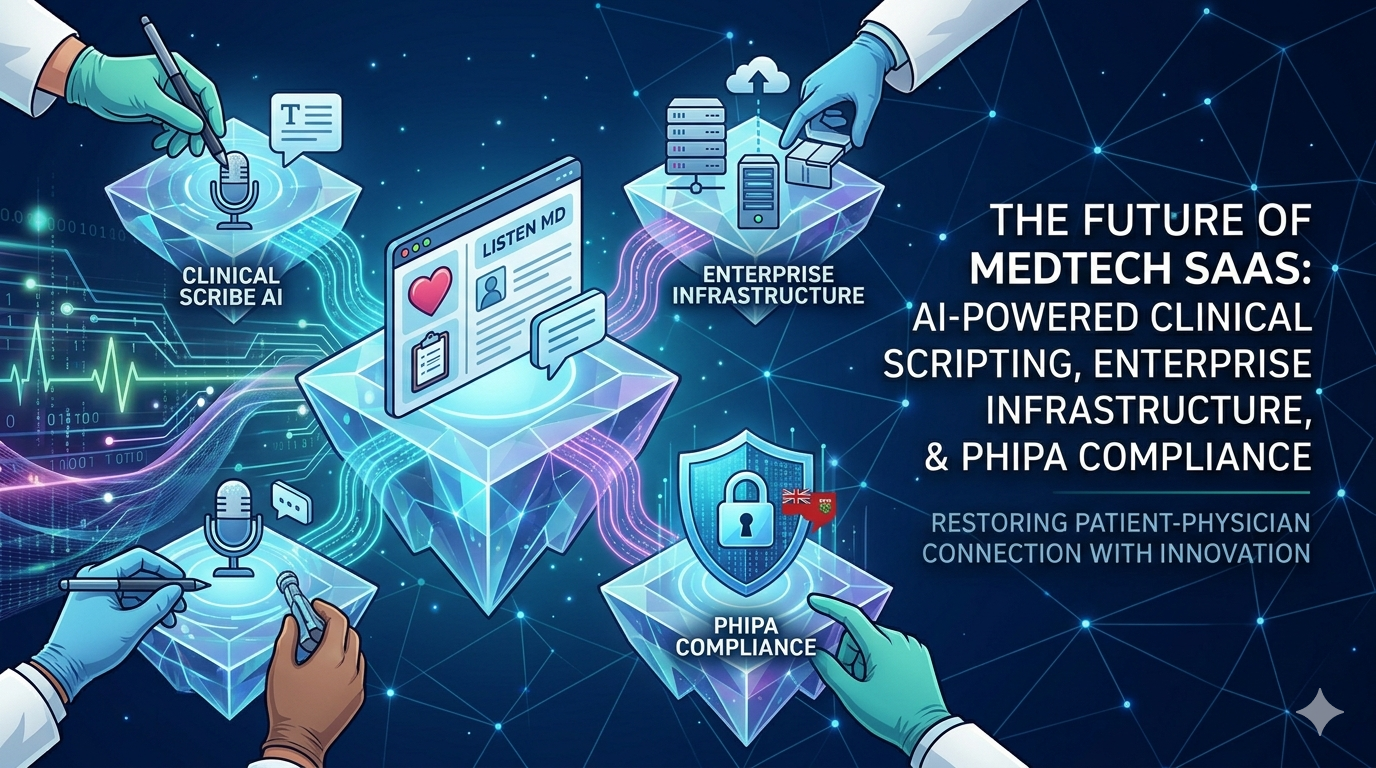
The emergence of MedTech SaaS and AI-powered clinical scribes, such as Listen MD AI Clinical Scribe and Platform, represents a fundamental shift in this paradigm. By leveraging Generative AI and Natural Language Processing (NLP), these platforms function as “invisible” medical assistants that listen to the clinical encounter and transform raw dialogue into structured medical notes in real-time.
The “Patients Before Paperwork” Mandate in Ontario Healthcare
The core mission of modern MedTech SaaS is simple: efficiency. When a platform can reduce the documentation load significantly, the results aren’t just statistical—they are human.
- Increased Clinical Throughput: Clinics can manage higher patient volumes without increasing the length of the workday.
- Enhanced Accuracy in AI Scribing: AI scribes capture nuances in dialogue that might be forgotten or summarized too briefly in manual charting.
- Physician Wellbeing & Retention: Reducing administrative friction allows doctors to focus on the practice of medicine, significantly mitigating the risks of professional burnout.
Predictive vs. Generative AI in Healthcare Systems
While Generative AI handles the scribe work, Predictive AI is the next frontier for MedTech SaaS. By analyzing historical patient data, these models can forecast potential health risks, suggesting preventative measures before a condition worsens. This dual-AI approach transforms a passive tool into a proactive clinical partner.
Part 2: Engineering the Infrastructure of Trust
Compliance, MLOps, and Enterprise MedTech Scalability
Building a MedTech SaaS platform for the general market is a technical challenge; building one for the Ontario healthcare sector is a rigorous engineering feat. When dealing with Personal Health Information (PHI), the standard “move fast and break things” startup mentality is replaced by a culture of absolute compliance and data integrity.
The Three Pillars of MedTech Compliance & Data Security
In Ontario, any platform entering the healthcare system must adhere to strict regulatory frameworks to ensure patient privacy and data security.
- PHIPA Compliance: The Personal Health Information Protection Act governs how PHI is collected, used, and disclosed within the province.
- SOC 2 Type II Certification: This proves that a company’s internal systems are designed to protect client data and that those controls are functioning effectively over time.
- Canadian Data Residency: For many Canadian institutions, ensuring that medical data remains within Canadian borders is a non-negotiable requirement for vendor selection.
MLOps and the AI Lifecycle in Medical Software
Integrating AI into a clinical workflow isn’t a “set and forget” operation. It requires robust MLOps (Machine Learning Operations) to ensure the models remain accurate and unbiased.
- Continuous Model Monitoring: Systems must be monitored for “model drift,” where the AI’s performance degrades as clinical terminology or standards evolve.
- Verified Audit Trails: Every AI-generated note must be verifiable. In a MedTech SaaS environment, the physician remains the “human in the loop,” reviewing and signing off on the AI’s output to ensure clinical validity.
- Healthcare Interoperability: A successful MedTech platform must integrate seamlessly with existing EMR/EHR systems, allowing for a unified flow of data across the healthcare ecosystem.
The Strategic Advantage of Open-Source Enterprise Foundations
Leveraging established enterprise foundations rather than building every component from scratch allows for faster deployment and better resource allocation. By focusing custom engineering on unique AI-native infrastructure—while utilizing secure, open-source frameworks—MedTech companies can reach market readiness with significantly higher reliability. If you are looking for medtech SaaS web design Toronto agency, visit DTW.
As a partner with a successful Supply Ontario Master Agreement for AI solutions, ECA Tech Inc. is committed to advancing Ontario’s digital health infrastructure.


